


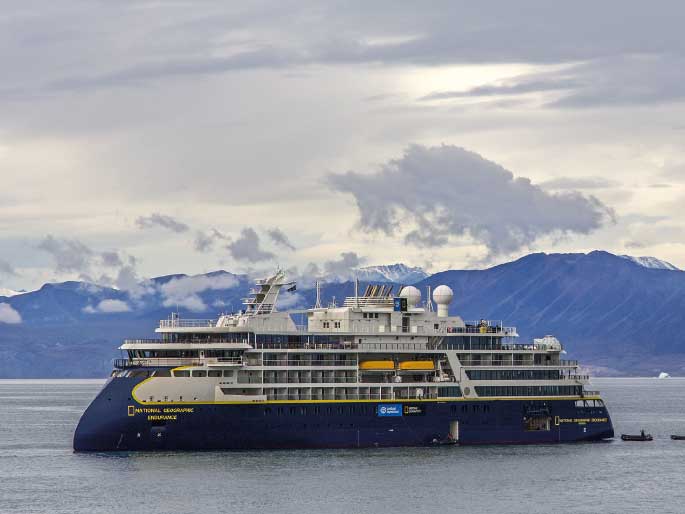
Exclusivity is to experience the legendary Arctic landscapes and wildlife of the Northwest Passage in the wake of Roald Amundsen, with the newly built National Geographic Endurance as your base. Journalist Peter Hanneberg rates the ship as state-of-the-art, best in class.
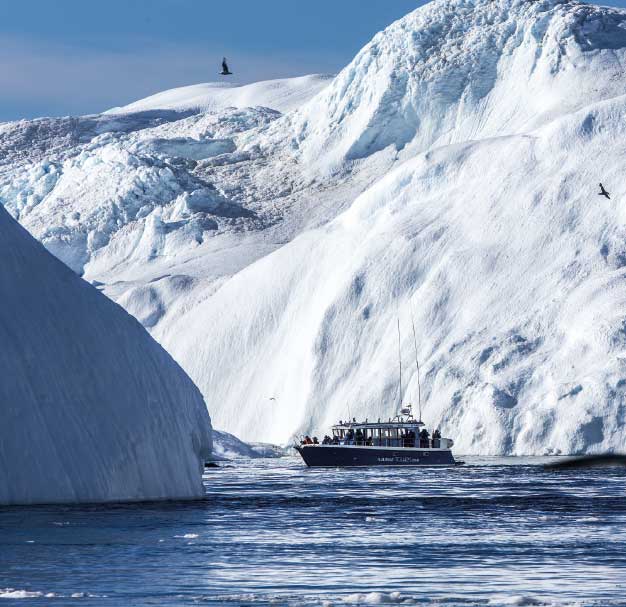
The ship's high standard is worth a special trip in itself, but the expedition is crowned by the exclusivity of the nature experiences. It is for them that one travels here.
”This is not a cruise, it is an expedition,” is the message from Lindblad Expeditions and National Geographic. As I embark Endurance, I am surprised by the solid feeling of quality that strikes me. Not perhaps what one would expect from an expedition ship. This feeling will only grow over the three weeks.
The combination of a ship on top and wilderness experiences in the Arctic is outstanding. Having this ship as a base to encounter the once so feared Northwest Passage and its exciting wildlife must be the wet dream of all nature and travel enthusiasts. Especially as the ship, in addition to all service and comfort, has also been equipped with every conceivable technical solution that increases sustainability and reduces environmental and climate impact during expeditions.
Ready for a zodiac tour
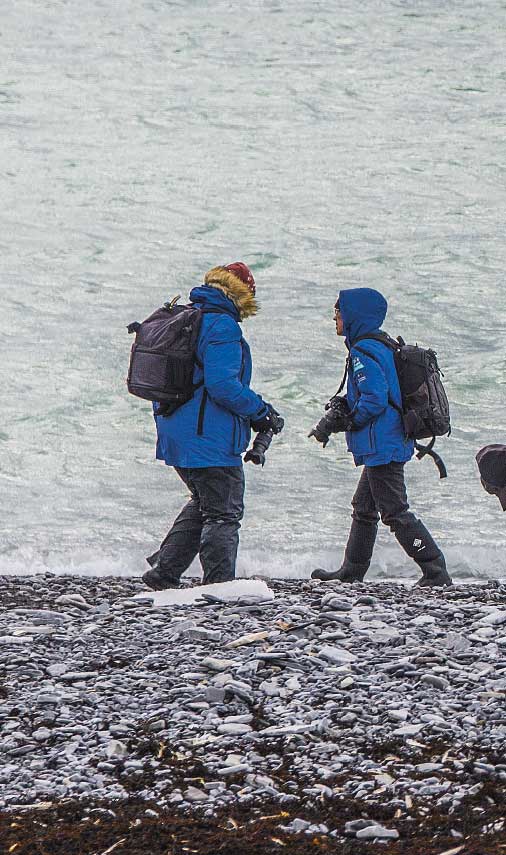
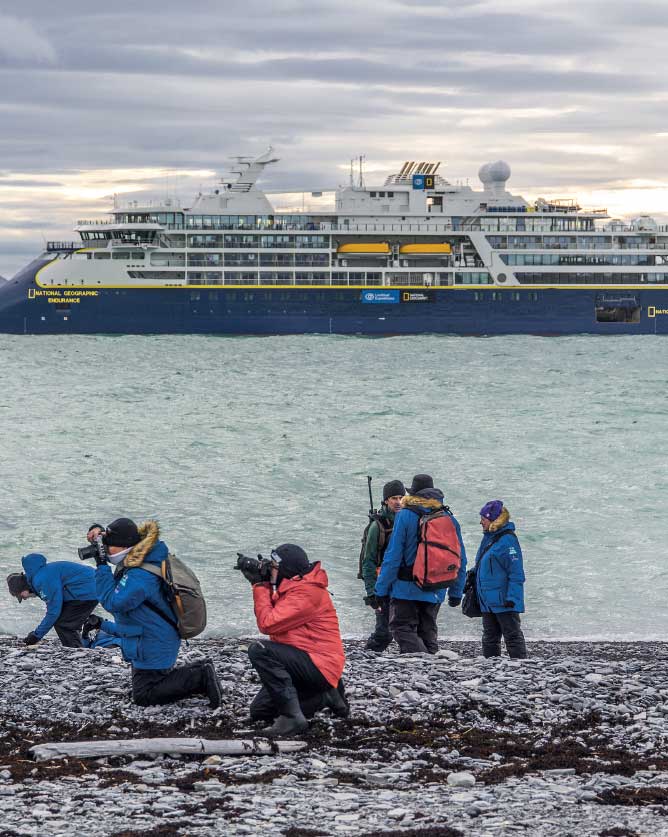
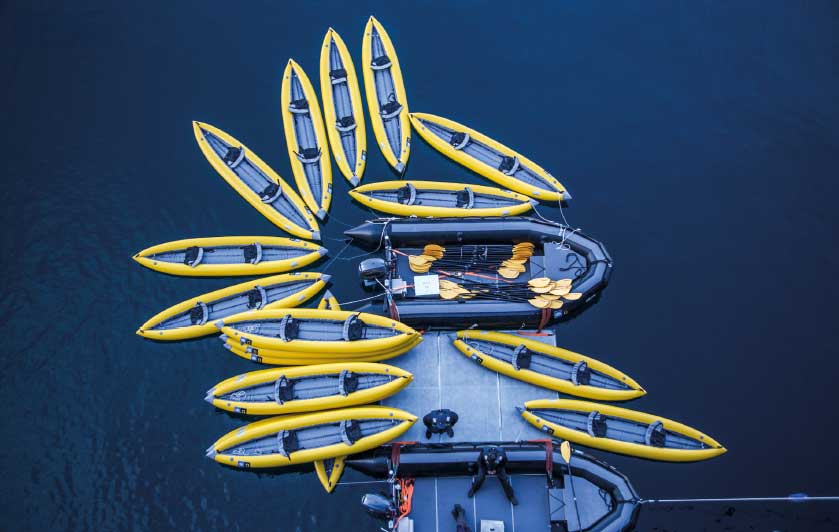
We spot the animals on land and at sea during different parts of the journey thanks to our skilled captain Oliver and the alert nature guides. Once wildlife has been spotted, a zodiac trip or a landing is quickly prepared. We go down to Basecamp On the Expedition Deck, they board the sturdy zodiacs, which are skilfully steered as close as we can get without disturbing the animal and natural world.
The ship's high standard is worthy of a trip in itself, but the expedition is topped by the exclusivity of the nature experiences. It is for them that one travels here. Encounters with the marine mammal species of the icy sea. Seals, the beluga whale, the humpback whale, the bowhead whale, the grey whale. And above all, the fascinating narwhal with its improbable spear-like tusk from its nose, which created the myth of the unicorn.
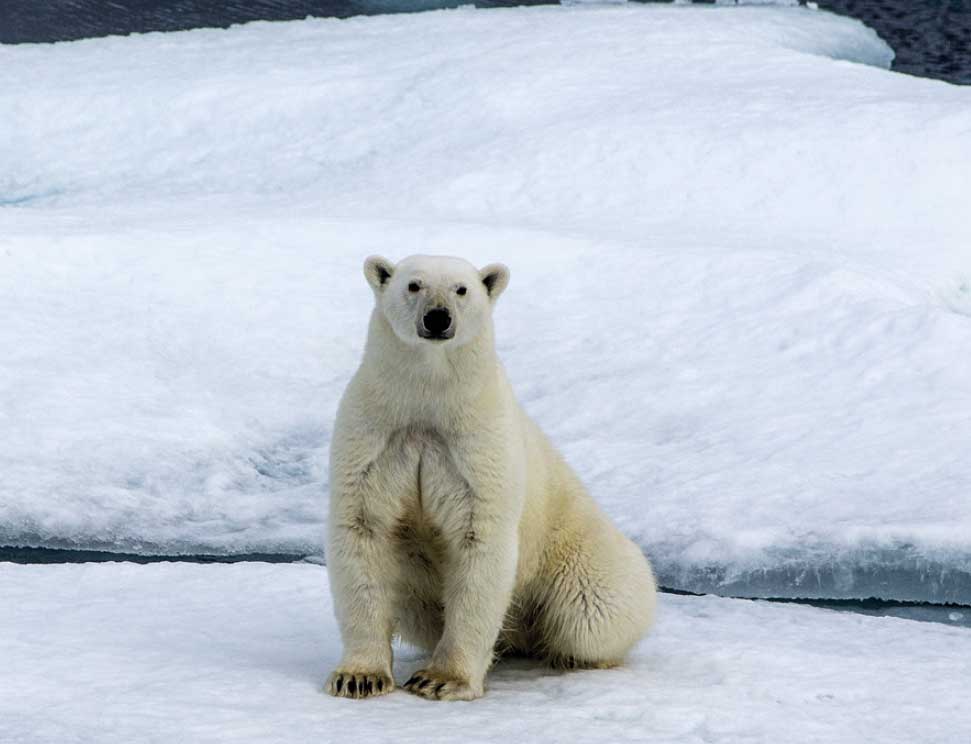
The wildlife on land. From the quay and the observation deck, we see wild polar bears jumping between the ice floes on the shrinking, high summer ice. We prefer to observe them through binoculars and telephoto lenses from the safety of Endurance's railings. A female and her yearling cub are eating a seal she has killed. Another is desperately, but in vain, trying to get at some beluga whales fishing near the shore.
Nature experts tell and show
We see musk oxen and reindeer in the distance when we are out on our walks across the tundra. We make special landings to follow the struggling plant life on the endless, exposed tundra. Lindblad's nature experts know what they are talking about; they are all well-educated in their respective fields.
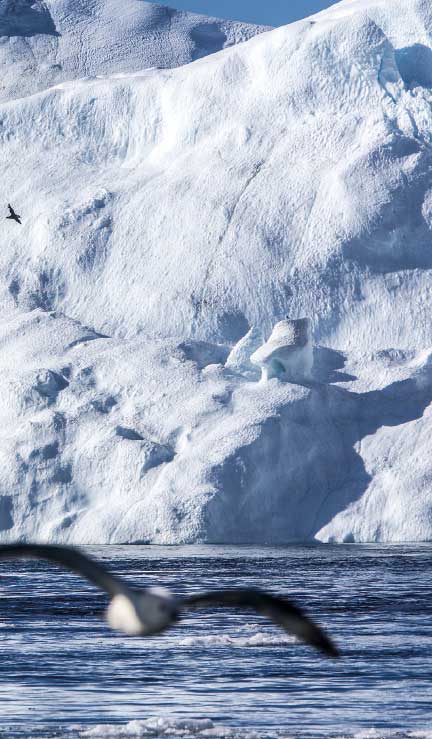
But it is also about the Arctic settlements. We encounter Inuit culture in their villages. Communities that give the impression of provisional frontier towns in the Wild West, or rather the Wild Arctic. The plants, animals, and people have in common that they all engage in a daily struggle to adapt to and survive in this, one of Earth's harshest climates and habitats.
We from Endurance are only visiting and can return to our floating home to be pampered with its beautiful interiors and good food. On the main deck, I am regarded by a weather-beaten Ernest Shackleton from large photographic portraits. National Geographic Endurance was named after the British national hero, whose expedition ship Endurance was destroyed by ice in Antarctica in 1915 during the much-hyped Imperial Trans- Antarctic Expedition 1914-17.
The plants, animals and humans have in common that they all engage in a daily struggle to adapt to and survive in one of Earth's harshest climates and environments.
The polar region on the wall
On the Lounge Deck and Observation Deck, I am captivated by the exciting paintings that transform the corridors into veritable art galleries. Photographic landscape art, with polar regions as the main theme, adorns the interiors everywhere. At the entrance to the Seven Seas Restaurant on Deck 5, I am welcomed by a gigantic oil painting on canvas by Julie Hefferman, titled Weather Change. It is a brilliant, floor-to-ceiling fantasy landscape symbolising climate change.
In the restaurant, the head chef is executing Gerardo Maniscalco. For three weeks, he composes menus with about ten dishes daily, which leave guests wanting for nothing more. He also invites ten guests at a time for a more private tasting at Charlie's Table, with ten small courses that connect in different ways to the theme of climate. The quality, rather, reminds me of Michelin.
This happens on the Observation Deck, where a small restaurant operates with its own kitchen and where Endurance's second bar is located. The chart room, a computer station called the Science Hub, and the round library with its magnificent view are also on Obs-deck.
Special delivery from the wine cellar
The wine list is exciting for an expedition ship with a maximum of 126 passengers, but the wines included with each meal are of fully sufficient quality and variety. House wines include Salentein Reserve 2017 Cabernet Sauvignon and Sancerre Guy Saget 2016. The ship has a wine cellar and a small wine tasting room.
One day you get a ”Special delivery” to his room. I myself am the happy recipient of an exquisite cabernet sauvignon in the higher price range, a Col Solare 2014 from Washington State. Such initiatives clearly illustrate Lindblad's generous attitude.
Aft on the Obs deck lies The Sanctuary with a spacious yoga studio for morning stretches, two saunas, The Terrace relaxation room and several rooms for spa treatments and massages. Two knowledgeable wellness experts are always available. The gym on the Bridge deck one level down is well-equipped with exercise equipment and beautiful views.
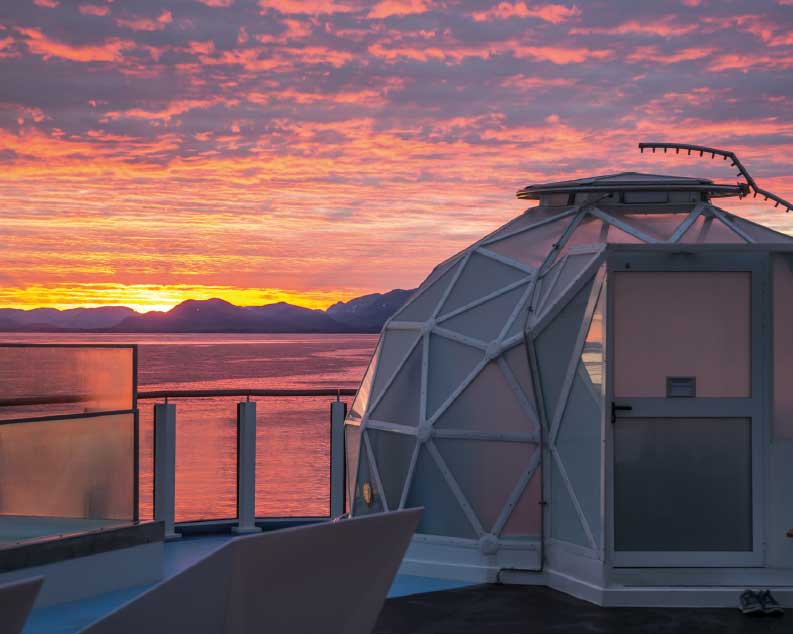
Igloo on board
More unusual are two round ”igloos” at both ends, which can be booked and stayed in with an unobstructed aft view from the double bed. Next to them, steam rises from individual plunge pools with 40-degree water, which are lovely to descend into after waking up in the cold, Arctic sunrise. In this spa water, I sometimes sit and philosophise about the furious development that has occurred since Roald Amundsen, 120 years ago, travelled these waters in his simple sailing ship, the Gjøa, and finally, after three winters with the Inuit, managed to complete the entire Northwest Passage for the first time by boat.
The bright, Scandinavian design is a recurring theme throughout the interiors. It is understatedly exclusive, without exaggeration or frills. The choice is typical of the owner due to his Swedish background. The New York-based, Swedish-American entrepreneur Sven Olof Lindblad is once again the pioneer, having commissioned this state-of-the-art vessel according to the X-bow patent. The bow slopes outwards instead of inwards. For polar conditions, the X-bow is a luxury. It lies more stably and belongs to the highest ice class. ”It doesn't look like a boat, possibly an upside-down boat,” says one of the nature experts.
A lust for adventure
Book your expedition and learn more about the ships and the various destinations that Lindblad Expeditions offers. The journey we joined was 22 days long, and is made once a year from Greenland to Alaska, just as Roald Amundsen sailed. Price this year from $37,730, departing July 24th. www.expeditions.com
Exclusive expedition ships
With small, exclusive expedition ships conducting nature studies, Sven Olof, together with National Geographic, has taken people to many of the Earth's unique and hard-to-reach natural and cultural environments over decades. The demanding and risky polar destinations require well-thought-out ship concepts. The new sister ships, National Geographic Endurance and Resolution respectively, are the crowning achievement of Sven's successes.
It was his Swedish-born father, Lars-Eric Lindblad, who invented the expedition concept in the 1950s and commissioned the first ship in 1969, the legendary Lindblad Explorer. With his ship, he opened up the world's most remote and exotic locations to the future, i.e. today's, ecotourism. He became the father of destinations such as Antarctica, the Arctic, Easter Island, the Seychelles, China, New Guinea, Africa, the inner Amazon and the Galapagos. With the Explorer, he also became the first, as early as 1984, to successfully take paying passengers through the Northwest Passage.
A life-threatening passage
Since the Western world began searching for the Northwest Passage around 1500, it has cost the lives of hundreds of seamen and ship captains. These were fearless exploratory expeditions that ended with ships being crushed by ice and sinking. Now, as climate change causes most of the ice to melt during midsummer, Endurance and Resolution are ready in July to force the passage.
Lars Eric Lindblad would be proud and fascinated if he saw how his son Sven Olof has developed his expedition concept during the thirty years after his passing in 1994. Both ships were completed just before the pandemic put the entire world on standby, but gave Sven and National Geographic plenty of time to plan and prepare the expeditions through the unique, previously impossible Arctic passages.
With such small and agile vessels of such high quality, with a crew as large as the number of guests, and with a range of experts on board to educate and guide the guests, the expeditions are of course expensive compared to the giant cruise ships that carry many thousands of passengers across the oceans. But for those who don't have to count every penny, Lindblad-National Geographic's expeditions are among the best that can be found today in terms of the best possible vessel quality and service combined with truly solid, educational experiences.