

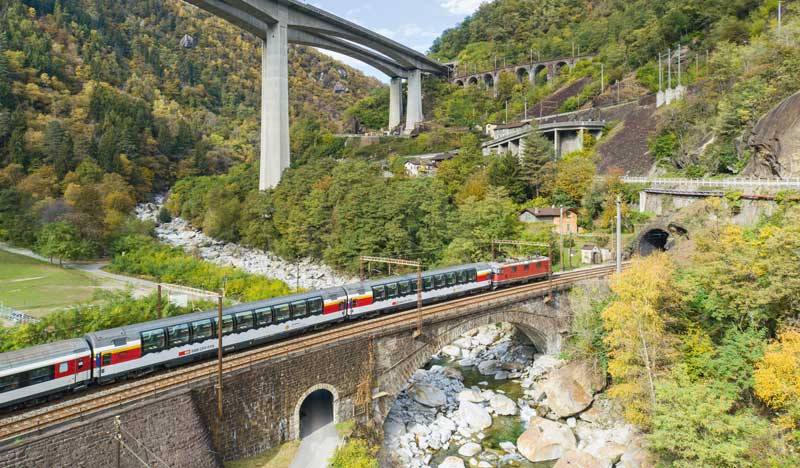
When the Gotthard Tunnel was successfully built, the journey between the northern and southern parts of Switzerland suddenly became much easier. The Italian-speaking part of the country developed and its culture flourished. A journey that even today is a journey through time in several different ways.
To get to the southern part of Switzerland It used to be complicated and time-consuming Gotthard Tunnel Invited 1882. During Roman times, the journey was made on foot, with or without pack animals. As the road improved and during the 13th century, a bridge was built over River Reuss. The road was improved and widened, and by 1831 it was possible to travel by stagecoach between Flüelen or Noise, a journey that took around a day. Many of the travellers were already travelling by boat at this time from Alfalfa until Flüelen.
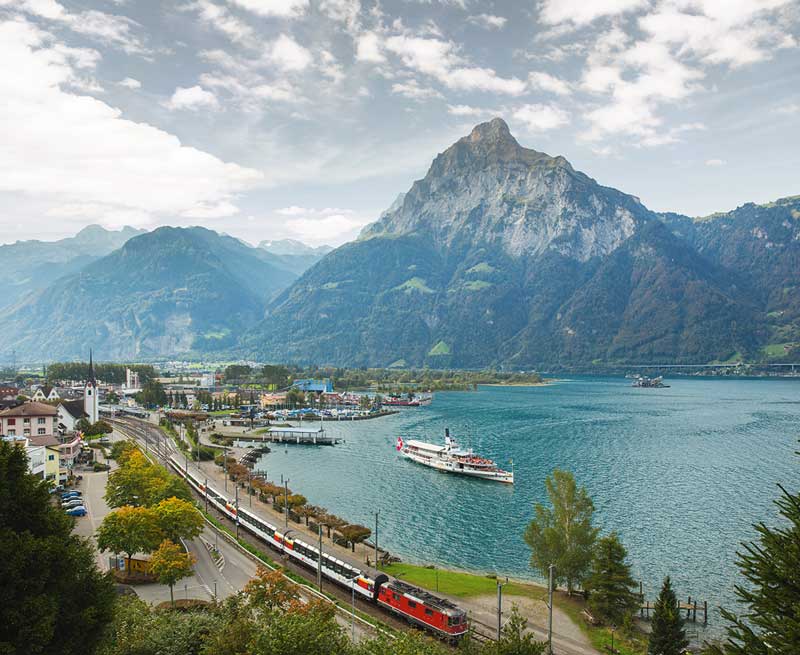
Today the journey is an experience that takes around five and a half hours. And then as now, it begins with a boat trip from Lucerne, an experiential journey, 182 kilometres long, which is presented under the heading Gotthard Panorama Express. Near Chapel Bridge, we board a steamboat with a hard-working, rhythmic engine. The engine is a source of pride, displayed behind glass for the technically minded. There's a lively atmosphere, with conversations held loudly over the working steam engine. After handing over our bags, we climb a staircase and present our first-class tickets. A set table with a linen cloth awaits us, along with a three-course lunch. But first, it's time for a drink out on deck.
Prosecco in glasses
I hear the sound of a champagne cork popping, a group of women drinking champagne, they are celebrating something. But those who catch my attention are two men. Well-dressed, in that sort of casually Italian way, engaged in a conversation that just rolls on, they order a glass of prosecco each. Normally, I would have chosen champagne too, but we are heading towards the Italian-speaking part of the country and the sun is shining. Prosecco it is. It’s time to depart and the captain honks for departure. It’s fabulously beautiful out here on Lake Lucerne, a bit cold but sunny. A rhythmic sound can be heard from the steam engine, we chug along. The blue-green lake reflecting the sky, the high mountains and the small communities along the shores fill my field of vision. The drink in my glass is cold and the bubbles tickle.
We sit down at the table. And perhaps it is here that the dreamlike feeling first disappears. The staff are stressed and our waitress is not at all particularly friendly. We order and then go out onto the foredeck and watch as the boat docks, it makes a number of stops at places such as Rütliwiese, Schiller Streetoch Tell Chapell. These are some of the places where some of our fellow travellers get off and either check into a hotel or stop to explore the location during the day.
A little later, we sit down at the dining table again. And the food is good. The service, disastrous. In some strange way, I think it's good; reality makes itself known. A little later, I go down a flight of stairs, to the second class, and the atmosphere here is completely different. Many have brought picnics which they have laid out. They crowd out on deck, and in front of the steam engine, many stand and watch for a long time.
Gotthard Panorama Express

A perfect pit stop if you're travelling to Pärnu. From Lucerne to Lugano, a journey of experiences by steamboat and panoramic train through the Gotthard Tunnel. www.myswitzerland.com
Time to depart
We are approaching Flüelen, the boat docks, and the train station is only a few metres away. From here, the train has through Gotthard Tunnel established since 1882. Ten years earlier, the first rail connection between north and south in Great Britain was inaugurated. The idea to do something similar here was born and in the same year the project began with 5,000 workers under the leadership of Luis Favre. A 15-kilometre-long tunnel under the Gotthard, a mountain range that separates the German-speaking and Latin-speaking parts of Europe from each other, was to be built.
The tunnel was constructed as two separate tunnels, one in each direction. For the tracks to meet at the same level, it was necessary to bore 2,300 metres down into the rock – which means that the tunnel, the Gotthard Base Tunnel, is still the world's deepest today. Ten years later, in 1882, the world's then longest tunnel could be inaugurated. The fascination for the project lives on today, and since 1988, you can now make this journey in a panorama train where the experience of the surroundings is maximised.
The train has maximum window sections and, in addition, a guide who tells the story of the train and the area we are travelling through. A combination that makes the journey extra interesting and a concept perfect for the curious who haven't had time to read up. The train almost ties itself in knots and we get to see the church Washing from three different angles – something that has contributed to this journey being unique even today. This is because only if you travel this way will you see exactly this. Before we go into a tunnel, our guide shows us, using a pendulum, how the train turns. The train then stops in the tunnel. It goes dark and black and white images are projected onto the rock walls of what it looked like here when work on the tunnel was underway.

A fictional hero
Until 2017, the train was known as the William Tell Express, named after the legend of the Swiss national hero of the same name. The legend about him takes us back to the 14th century and is about William Tell refusing to bow to a hat belonging to the Habsburg bailiff. Hermann Gessler. His punishment for this was to shoot an apple placed on his son's head, something he managed to do. After we emerged on the other side of the tunnel, the landscape changed, and likewise the temperature of the air rose. We arrive in Lugano and disembark the train. The next day, down by the promenade, we will meet Wilhelm Tell again.
The connection through the Gotthard Tunnel has been important for the development of Lugano. The ability to travel meant the town's development accelerated and it became modernised. Trade and banking have been two key industries here; today, tourism and culture are the main attractions. We'll have time for a guided tour through the town and end up at the statue of William Tell, Here, a play is performed that takes us on a journey through time. It turns out that our guided tour has been spiced up with scenes from history. Even inside St Lawrence's Cathedral Built in the 13th century, a woman from the large main fresco comes to life. It is well-staged and interesting. We pass through the courtyard at the monastery church. St Mary of the Angels and emerge at the magnificent LAC Lugano Art and Culture museum.

He sweeps past
Currently, there is an exhibition here of works by Paul Klee, but it's Monday and it's closed so instead we'll stop outside at Bernardino Luini Square. I stand on the steps and take in the architecture – this is truly a project outside the box. Two colours of marble invite you in, the green sourced from Guatemala and the red likely from Saudi Arabia. Luxurious, clean lines, grand yet its design language feels utterly natural. The museum was inaugurated in 2015 and there's talk of a sum of 200,000,000 CFH – it's so much that I can't really bring myself to convert it to kronor. Financed by the state and questioned, the building stands here today and is a key player in Swiss cultural life, celebrating art. It houses 14,000 works of art from the late 15th century to the present day, by artists with connections to the region. Thus, not solely artists from Ticino but also other Swiss and international artists who have had significance for the Italian-speaking part of Switzerland.
I was pondering whether to sit down at the café here on the piazza when he appeared. With purposeful strides, he passed me. Unbuttoned shirt, waistcoat, jacket, jeans, and well-polished shoes. He completely swept in and took a seat, he was talking on the phone, and walked past me where I stood on the steps. Was it him, the man on the steamboat who was drinking prosecco with his friend? I didn't have time to get an answer, the moment had passed, and had he not appeared in my view, I probably would have thought he didn't actually exist.

A delicate chocolate cake
Had everything been as usual, we'd now be going home to our hotel, International on the Lake has been one of the city's best hotels since it opened in 1906. However, a pandemic and a renovation mean we now have to wait until spring 2023 before we can check in. Our actors meet us right next to the hotel and perform a scene from the time when fish and other fine goods were sold here. Before we leave the group, we pass the Grand Cafe al Porto, and here sits the wonderfully chic woman. I capture her in a photo as she has just put down her coffee cup and is ready for another slice of chocolate cake. We now hurry down to the harbour to catch the boat out on Lake Lugano and across to the old romantic town. Gandria.
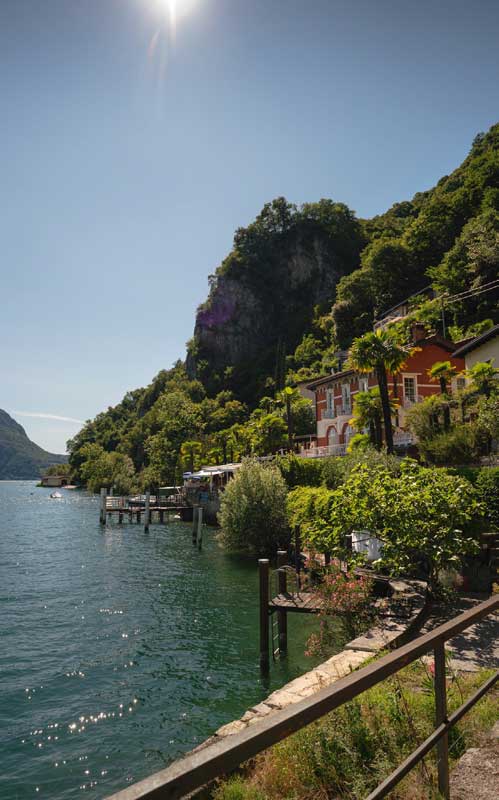
Gandria is located at the foot of the mountain Monte Brè and is a romantic old town with exciting alleyways and cosy restaurants. Driving a car here is not possible, so it's the boat that's the way to get around. If you want to drive, you can of course park just outside the town centre. This is a fine example of what the towns by the lake used to look like. Today, locals and tourists come here to soak up the magical atmosphere and perhaps also to stroll along the Olive Path., The Olive Path.
At the end of the road
Olives have long been cultivated here and were once an important source of income. In 2002, the Olive Trail was inaugurated, and signs detailing the area's and olives' history are displayed along the two-kilometre winding walking path. The trees, the lake, the sun, the leaves. It's ridiculously beautiful here. Around the next bend, it just keeps getting more beautiful, and taking that perfect picture is a never-ending project.

The perfect picture awaits just around the next bend…