

This time we don't just pour regular champagne into the glass, we choose the pink variety. Here we recommend three fantastic rosé champagnes perfect for when you want to romance or match with food. Notes of red berries, orange and nougat are waiting to be released from the bottle.
OUR CHAMPAGNE TRIO all have their own individual character and history. Made from different grapes and in different ways. Anyone interested probably knows that only three different grapes are allowed to be included in a champagne: the green grape chardonnay and the blue grapes pinot noir and pinot menunier.
To then produce a rosé version, there are two different methods, blending or maceration. Blending is exactly what it is called and involves adding around ten percent red wine. Champagne is today one of the few regions where it is permitted to make rosé wine in this way, and here it is also the most common method for producing rosé champagne. Maceration is done by crushing the skins of the red grapes after the harvest and then allowing them to ferment in the first fermentation for anywhere from a few hours to a few days. The longer the skins are involved in the fermentation process, the more intense the color becomes.
If you open a bottle of Ruinart and don't want another glass then I've done something wrong.
Ruinart, first on the market
The Ruinart champagne house was founded in 1729, which was the year after it was allowed to transport wine in bottles. Among the first customers were Napoleon, the Russian Tsar and the court in London. It has also been shown that Ruinart was the very first to bring a rosé champagne to the market. When they delved into the archives, they found a sales document dated March 14, 1764 where 60 of the 120 bottles to be delivered were marked as ”Oeil de Perdrix”, a description of the color of the wine as pink with a tone of copper. Presumably, the color was due to long skin contact with the blue grapes, maceration. However, this was not really a ”finished” product for the market.
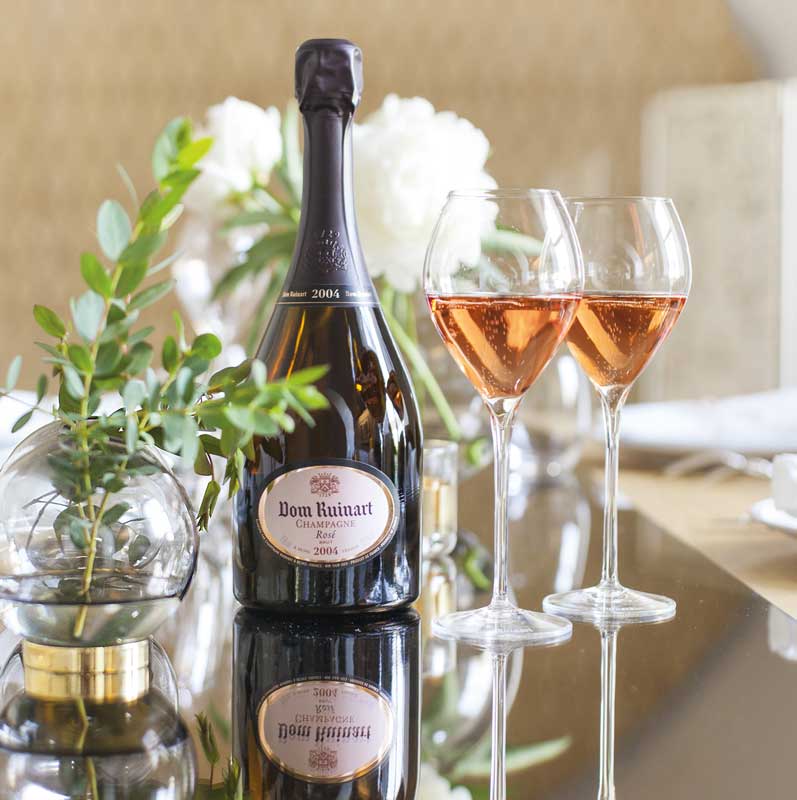
Ruinart rosé brut
no. 82872, 799 SEK/750 ml
Red berries in the form of both raspberries and wild strawberries are offered in this glass, as well as nuts, peach and brioche. A lovely mousse, fine minerality and a long finish.
A blend of chardonnay and pinot noir.
When I met the house's current Chef du Cave Frédèrik Paniotïs in connection with the Ruinart Challenge sommelier competition, he offered a lecture on the topic of how we name the color of a rosé. According to him, a "real" color key where shade and depth can be identified is what matters. Our descriptions of color are rarely accurate, he says, and instead shows an image of a section of the color wheel:
“When I work with our non-vintage rosé, this is the color I want,” he explains, pointing.
The color should be the same from year to year in the non-vintage version. When creating the prestigious Dom Ruinart, however, it is not of the same importance that the color is exactly the same every year. The focus, however, is on the champagne being good:
– If you open a bottle of Ruinart and don't want another glass, then I've done something wrong, he says, topping up my glass with some Dom Ruinart Rosé.
Champagne glass
A slightly more luxurious champagne is best served in a glass that is neither too wide nor too narrow. A regular white wine glass is the easy solution!
Laurent-Perrier, masters maceration
The champagne house Laurent-Perrier was founded in 1812 in Tours-Sur-Marne by André Michel Pierlot, who had previously made aging barrels. After this, the house was inherited by his son, but since he had no heir, Laurent-Perrier ended up in the possession of Eugène Laurent. He died in an accident in the wine cellar in 1887 and his widow Mathilde Emelie Perrier took over the business, and it is she who is also behind the fact that the house was named Laurent-Perrier.
From 1939 the house was run by the widow Marie-Louise de Nonancourt and it was only after the war that her sons Maurice and Bernard took over the business that it began to flourish. They had distinguished themselves in the war and now developed the company, linked winegrowers with good vineyard locations to the business and sales increased. Milestones in the history are a zero dosage wine, the prestigious Grand Siècle wine and of course Cuvée Rosé. Since 2005 Bernard's daughters Alexandra have been running the house, and recently the fourth generation of the Nonacourt family also stepped into the business.
The year was 1968 when Bernard de Nonancourt launched Cuvée Rose. Since then, a highly regarded rosé created from 100% pinot noir from ten different vineyard locations. The grapes are destemmed and then macerated for between 48–72 hours depending on the current harvest. Today, winemaker Michel Fauconnet holds the reins of the house.
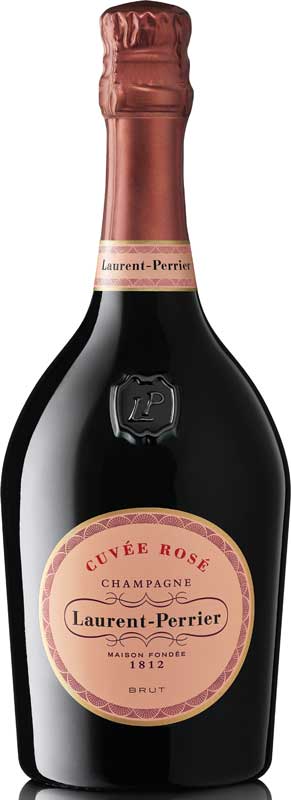
Laurent-Perrier, masters maceration
no. 74804, 899 SEK/750 ml
An elegant scent of red berries invites you in – deluxe raspberry juice for adults! The taste is smooth and the berry notes are clear: raspberries, strawberries, wild strawberries, cherries and red currants. The mouthfeel is nice, as is the mousse. Every now and then this one also appears in extra stylish packaging. A nice gift for myself.
Madame Clicqout, mixes fresh
The champagne house Veuve Clicquot was founded in 1772, but it was not until 1818 that Madame Barbe-Nicole Clicquot created the first more commercial rosé champagne. Her vision was a wine with character in taste, aroma and color. She simply chose to pour a little red wine into the standard champagne that we in Sweden know as the ”Yellow Widow”. For today’s rosé blend, current Chef du Cave Didier Mariotti uses 44-48% pinot noir, 13-18% pinot meunier and 25-29% chardonnay, to which a third of reserve wine is added. Just as before, the starting point is a classic ”Yellow Widow” to which 12% still red wine is added.
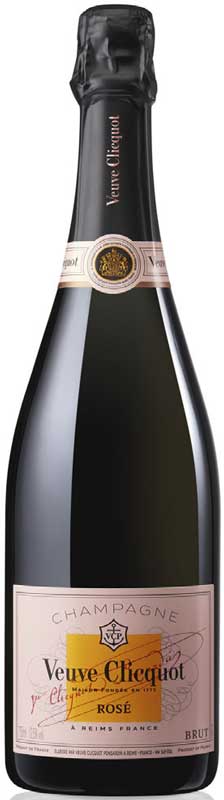
Veuve Clicquot Rosé
Available for purchase in Taxfree This full-bodied champagne is almost copper-colored and offers a lot of strawberries in both taste and aroma. Add notes of cherry, red grapefruit, hazelnut and apricot and we are treated to a flavorful and complex champagne with a fine structure.