


The puff, the bubbles and the cold drink tickle the throat and force the corners of the mouth upwards. There is something a little magical about Champagne, a drink and a destination well worth diving into.
Driving into Reims, the capital of Champagne, is a bit of a shock. The traffic is heavy, a roundabout and voila, we are at the home of Veuve Clicquot. To get to Sans, we drive up the hill, pass Pommery and turn into the restaurant Le Jardin, a 1-star ”casual” eatery. The garden is in bloom and the air is clear. To catch our breath, we enjoy a mushroom veloute, a fish fillet with wasabi sauce and a lemon pie, accompanied of course by a glass of ”Gula Änkan”.
The Big House – Veuve Clicquot
We begin the visit by going down into the magical limestone cellars that have been listed as a UNESCO World Heritage Site since last year. It is often said that the interior of Reims looks like Swiss cheese; as early as the 4th century, the Romans began digging up limestone to obtain building materials for the city. Today, there are over 200 kilometers of passages here, many of which are now used to store champagne. During the First World War, 20,000 people lived here, there was a hospital at Veuve Clicquot and a school at the neighboring house Pommery. Today, Veuve Clicquot rummages in 24 kilometers of these cellars. The fact that all 16,000,000 bottles of champagne that the house produces annually are stored here is a bit breathtaking.
Together with Delphine Laborde, one of the house's ten winemakers under Chef de Cave Dominique Demarville, we get the opportunity to taste the base wine. It is this wine that will then be blended into the blend that will produce a champagne with the same taste year after year.
“We usually grade the different base wines and then decide whether they should be stored or used,” says Delphine Laborde, who at 32 years old is the house's youngest winemaker.
If you're lucky, you might even be checked into Hôtel du Marc, which offers rooms and food in true Veuve Clicquot style. Free access to the house champagne is a given, as is the opportunity to cook with the house's phenomenal chef Christophe Pannetier. We get the key to a room with a bathtub from which you can see the magnificent cathedral.
The story of the house
Veuve Clicquot was founded in 1772 by Philippe Clicquot, whose son Francoise married Nicole-Barbe Ponsardin. Shortly after the marriage, the then 27-year-old Nicole became a widow and heiress to four hectares of vineyards that produced 8,000 bottles of champagne annually. She decided to continue the company. Gifted with business acumen, courage and a passion for innovation, she began a success story.
Madame developed a ”riddling table”, a form of stand with drilled holes where the bottles are inserted and then rotated. During the rotation process, the sediment collects closest to the cork. The result is fewer exploded bottles and less spillage during disgorging. The method was also adopted by competitors, but today it is cooling the bottle neck that is used in more industrial production. By preparing for export to Russia after Napoleon’s victory in 1811, the house took a lead in the export market. The label, which has become increasingly yellow over the years, is also something that has contributed to its success. Today, the house offers a fine collection of Clicquot yellow souvenirs from umbrellas to camping trailers, and designers such as Karim Rashid have also been involved in creating clever yellow champagne accessories. Today, the house is number two in size, only Moët & Chandon is larger.
Address: 1 Place des Droits de l'Homme, Reims
Tips:
Every year at harvest time, in September or October, a special VIP day is organized where everyone is welcome to help – keep an eye on the website.
About the wine
Historically, champagne was sweet, at the end of the 19th century we are talking about a dosage of 30–40 grams/liter, the one intended for the Russian market was even sweeter and offered a dosage of 250 grams/liter. With today's Rich, we are back to a dosage of 30 grams/liter.
Champagne tips
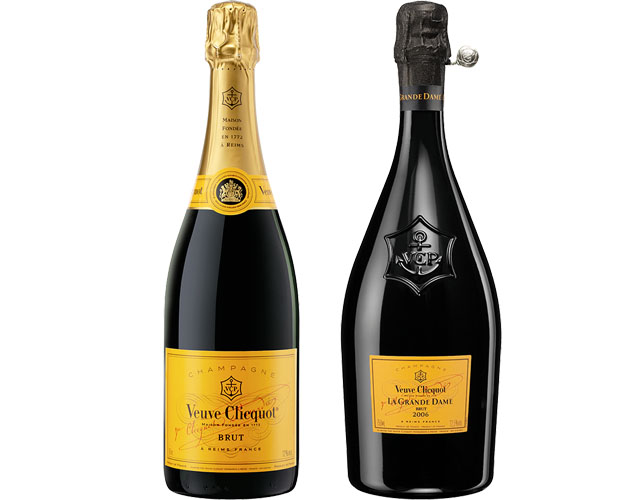
- Veuve Cliquot Brut “Yellow Widow”, 7424
Fruity and elegant on the nose, balanced taste with fine minerality. A classic. - Veuve Cliquot La Grand Dame 2006
Here we are treated to a nice mousse and a
Ornate texture. Bread and fruit in layers upon layers.